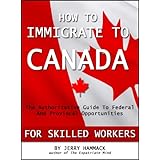
My eBook, How To Immigrate To Canada For Skilled Workers: The Authoritative Guide To Federal And Provincial Opportunities is available now on Amazon and other online retailers. Get your copy of the essential guide to Skilled Worker class applications today!

For Kindle
For iPad/iPhone
For Nook
For Kobo
For Sony eReader

Also available is my new eBook, "How To Immigrate To Canada In The Family Class: The Authoritative Guide Including Québec And Super Visa Opportunities". Get it at Amazon or the other e-retailers noted above.

Thursday, May 22, 2014

ADAMS, MACKLIN AND OMIDVAR - Citizenship Act will create two classes of Canadians

"Consider this scenario: A foreign student completes her master’s degree here in three years. She wants to stay in Canada – and is just the kind of highly skilled immigrant Canada needs – but she’s not eligible to apply for permanent residence yet. First, she must find suitable employment and work for a year. Having done so, she applies for permanent resident status, which takes another year to process. She has now been in Canada for five years, but none of it counts toward the four-year permanent residency requirement. Under the old rules, she would have received partial credit for years lived in Canada as a temporary resident. No more.

She is now a permanent resident, just at the starting line of the four years she must spend in Canada to apply for citizenship. Her Canadian employer asks her to work in one of its overseas offices (perhaps to take advantage of her language skills and cultural knowledge). But under the new rules any time spent outside Canada will further delay her eligibility for citizenship and could even jeopardize her permanent residence. She refuses the career opportunity.

Four years later, she has fulfilled her permant residence requirement and applies for citizenship. Based on existing delays (the result of staff shortages, not law), she will have to wait about two years before her application is processed. She’s been here for eleven years, six of them as a permanent resident. Only now can she call herself “Canadian” and vote for the representatives that collect her taxes and make decisions that affect her life."

Read the excellent, entire article here

Monday, May 12, 2014

The Globe and Mail - Canada must see immigration as a competitive edge

Gordon Nixon writes:

Diversity and immigration are important parts of Canada’s past, present and future.

Canadians have built a prosperous and civil society, one rich in opportunity, that people of many different cultures call home. Our economic strength is derived from the combination of what we all have in common and what makes each of us different.

Immigration has become a hot topic in Britain ahead of elections in 2015 but a new report by the Centre for Entrepreneurs shows they are crucial to the economy, responsible for starting one in seven UK companies. Hayley Platt talks to one migrant who came to England as a boy 42 years ago and is now a multi-million pound hotelier.

Canada welcomes almost a quarter of a million permanent immigrants each year – one of the highest rates of all developed countries. It is projected that 28 per cent of Canadians will be foreign-born by 2031 up from 20 per cent today. Canada must remain a destination of choice for skilled immigrants – entrepreneurs, professionals, scientists. Talent is more mobile and potential immigrants have more choices than ever before, with predictions of skills shortages for many developed economies. Simply opening our doors is not enough.

Read more here

Friday, May 02, 2014

Submitting a complete immigration application - a CIC How-To

This tutorial video shows you how to complete your application correctly and avoid common errors that can cause delays. It will help anyone traveling or immigrating to Canada, applying for Canadian citizenship, sponsoring a refugee or filling out other Citizenship and Immigration Canada applications.


Thursday, April 24, 2014

Miscalculation! CIC opens up double the categories for Federal Skilled Worker program

Some bean counter must have got his estimations wrong. After years of clamping progressively downward on the Federal Skilled Worker program, CIC announced Wednesday that it is opening the program up to 50 NOC categories (up from 29 in the last iteration of the program) and 25,000 applications.

Here are some details from the CIC:

On April 26, 2014, Citizenship and Immigration Canada (CIC) will issue a new set of Ministerial Instructions to immigration officers regarding the processing of applications to the Federal Skilled Worker Program (FSWP), Federal Skilled Trades Program (FSTP), and Canadian Experience Class (CEC).

Effective May 1, 2014, the following measures will be in place:

Federal Skilled Worker Program:
Federal Skilled Workers are chosen as permanent residents based on their ability to prosper in Canada. They are assessed according to a selection grid made up of six factors, including language, education, work experience, etc.

Overall cap of 25,000 applications in eligible occupations stream.

  • Cap of 500 applications for PhD eligibility stream
  • No limit on applicants who have a valid job offer from a Canadian employer
  • Sub-caps of 1,000 applications for each of the 50 eligible occupations below (their 2011 National Occupational Classification (NOC) code is included in brackets):
  • Senior managers – financial, communications and other business services (0013)
  • Senior managers - trade, broadcasting and other services, n.e.c. (0015)
  • Financial managers (0111)
  • Human resources managers (0112)
  • Purchasing managers (0113)
  • Insurance, real estate and financial brokerage managers (0121)
  • Managers in health care (0311)
  • Construction managers (0711)
  • Home building and renovation managers (0712)
  • Managers in natural resources production and fishing (0811)
  • Manufacturing managers (0911)
  • Financial auditors and accountants (1111)
  • Financial and investment analysts (1112)
  • Securities agents, investment dealers and brokers (1113)
  • Other financial officers (1114)
  • Professional occupations in advertising, marketing and public relations (1123)
  • Supervisors, finance and insurance office workers (1212)
  • Property administrators (1224)
  • Geoscientists and oceanographers (2113)
  • Civil engineers (2131)
  • Mechanical engineers (2132)
  • Electrical and electronics engineers (2133)
  • Petroleum engineers (2145)
  • Information systems analysts and consultants (2171)
  • Database analysts and data administrators (2172)
  • Software engineers and designers (2173)
  • Computer programmers and interactive media developers (2174)
  • Mechanical engineering technologists and technicians (2232)
  • Construction estimators (2234)
  • Electrical and electronics engineering technologists and technicians (2241)
  • Industrial instrument technicians and mechanics (2243)
  • Inspectors in public and environmental health and occupational health and safety (2263)
  • Computer network technicians (2281)
  • Nursing co-ordinators and supervisors (3011)
  • Registered nurses and registered psychiatric nurses (3012)
  • Specialist physicians (3111)
  • General practitioners and family physicians (3112)
  • Dietitians and nutritionists (3132)
  • Audiologists and speech-language pathologists (3141)
  • Physiotherapists (3142)
  • Occupational therapists (3143)
  • Respiratory therapists, clinical perfusionists and cardiopulmonary technologists (3214)
  • Medical radiation technologists (3215)
  • Medical sonographers (3216)
  • Licensed practical nurses (3233)
  • Paramedical occupations (3234)
  • University professors and lecturers (4011)
  • Psychologists (4151)
  • Early childhood educators and assistants (4214)
  • Translators, terminologists and interpreters (5125)


Federal Skilled Trades Program:
This program is for people who want to become permanent residents based on being qualified in a skilled trade.

Overall cap of 5,000 applications.

  • All 90 skilled trades from the following NOC Skill Level B groups are eligible (with sub-caps of 100 applications each): 
  • Major Group 72: Industrial, electrical and construction trades;
  • Major Group 73: Maintenance and equipment operation trades;
  • Major Group 82: Supervisors and technical occupations in national resources, agriculture and related production;
  • Major Group 92: Processing, manufacturing and utilities supervisors and central control operators;
  • Minor Group 632: chefs and cooks;
  • Minor Group 633: butchers and bakers.

Canadian Experience Class:
This program is for people who already have skilled work experience in Canada and want to immigrate permanently.

Overall cap of 8,000 applications.

  • Sub-caps of 200 applications each for any NOC B occupation
  • Six ineligible occupations: administrative officers (NOC code 1221), administrative assistants (1241), accounting technicians/bookkeepers (1311), cooks (6322), food service supervisors (6311), and retail sales supervisors (6211).

The new Ministerial Instructions will also re-confirm the existing pause of applications to the federal Immigrant Investor and Entrepreneur Programs.  

Tuesday, April 22, 2014

The Globe and Mail - After 40 years, Immigrant Settlement Program needs an overhaul

Robert Vineberg is a Senior Fellow at the Canada West Foundation. He was formerly Director General of Citizenship and Immigration Canada’s Prairies and Northern Territories Region. He is also the author of the book "Responding to Immigrants’ Settlement Needs: The Canadian Response".

Would-be immigrants to Canada continue to face a series of bureaucratic impediments that either delay their status or reduce the effectiveness of integration once they arrive here. Fixing these problems is long overdue.

Read more

Tuesday, April 15, 2014

CIC - Offering "Express Entry" to Qualified Economic Immigrants

April 8, 2014 — Ottawa — Canada’s Citizenship and Immigration Minister Chris Alexander today announced that Canada’s active recruitment model for economic immigration will officially be called “Express Entry.” Set to launch in January 2015, “Express Entry” is a major step forward in the transformation of Canada’s immigration system into one that is fast, flexible and focused on meeting Canada’s economic and labour needs.

“Express Entry” will allow for greater flexibility and better responsiveness to deal with regional labour shortages, and help fill open jobs for which there are no available Canadian workers. “Express Entry” candidates who receive a valid job offer or nomination under the Provincial Nominee Program (PNP) will be quickly invited to apply for permanent residency – a key distinction between “Express Entry” and the Temporary Foreign Worker Program, which is only used to fill temporary labour and skill shortages.

Formerly referred to as “Expression of Interest”, “Express Entry” will be open to skilled immigrants and allow the government to select the best candidates who are most likely to succeed in Canada, rather than those who happen to be first in line. It will also prevent backlogs and allow Citizenship and Immigration Canada (CIC) to better coordinate application volume with the annual immigration levels plan.

Learn more

Thursday, April 10, 2014

Hire a new immigrant - stop discrimination now

Hey Canada, this one's for you:

I would like all employers out there to consider dropping the phrase "Canadian experience" from their vocabularies. This subtle form of discrimination is keeping thousands of immigrants from getting work that they are fully qualified to perform.

By using this phrase, whether in an interview, or in an internal screening process, you are effectively practicing a form of discrimination through exclusion and also a very negative form of nationalism.

Think about this: Canada has one of the highest percentages of permanent residents that become citizens in the world - over 80% at last count. When you exclude a fully qualified immigrant from contributing to your company solely because they haven't worked for a Canadian employers for X-years, you are actually doing a great harm in the long term to your own country.

I've been asked the "Canadian experience" question on a number of interviews, and as soon as it's asked, I know the job isn't mine. I know that the person asking has a built-in bias that somehow all the years of experience I bring to the table mean nothing unless that experience is in Canada.

Think about how crazy that is. Let's say your hiring a Toyota mechanic. You have a choice between someone who has 10-years of experience in Japan, or someone who has two years of Canadian experience. No question of who should get the job, eh? But in Canada, subtle things come into play. Without Canadian experience, will the employee be able to "fit in to the culture"? Do they have the "soft skills" that Canadians possess?

I'm asking all employers out there to expunge the phrase "Canadian experience" from your vocabulary. Think about the long term. Heck - think about the short term too! Simply hire the best person for the job, no matter what.

It's not much to ask. 

Wednesday, April 02, 2014

CIC - New Canadian citizens in March 2014 almost double compared to one year ago

Here's the latest from the CIC, and the really good news is that this is not an April Fools joke!

April 1, 2014 — Ottawa — Approximately 33,700 people from 199 countries became Canadian citizens at citizenship ceremonies held across Canada in March 2014. This is almost twice as many compared to March 2013 when 17,089 people were granted citizenship across Canada.

Canada’s new citizens were welcomed at 312 citizenship ceremonies held across the country, from college campuses to Citizenship and Immigration Canada offices, to special ceremonies at railway stations and designated heritage sites.

These high numbers demonstrate that changes and improvements in effect over the past year have already made the system more efficient and resulted in a decreased backlog, helping more people realize their dream of becoming Canadian sooner. The government’s proposed changes in Bill C-24, the Strengthening Canadian Citizenship Act, will further reduce wait times by streamlining the decision-making process for citizenship. It is expected that these changes will bring the average processing time for citizenship applications down to under one year and that the current backlog will be reduced by more than 80 percent by 2015-2016.

Quick facts

  • So far in 2014, Canada has welcomed more than 75,900 new citizens at 759 ceremonies across Canada. Comparatively, in the first three months of 2013, Canada welcomed 35,320 new Canadians.
  • In 2013, 128,936 people were granted Canadian citizenship—an average of 10,745 each month.
  • Since 2006, Canada has enjoyed the highest sustained levels of immigration in Canadian history—an average of 257,000 newcomers each year. Accordingly, the demand for citizenship has increased by 30 percent.
  • Canada has the highest rate of naturalization in the world—85 per cent of eligible permanent residents become citizens. Citizenship and Immigration Canada received 333,860 citizenship applications in 2013, the highest volume ever.

Thursday, March 20, 2014

Nova Scotia announces new options for skilled workers


If you want to immigrate to Canada, but don't qualify for the Federal Skilled Worker Program because of all of the changes and limitations, Nova Scotia may have a solution for you:

The new Regional Labour Market Demand stream is aimed at selecting individuals who meet the labour market needs, are destined to join the labour market with a full-time and permanent position, and wish to live in the Province of Nova Scotia permanently.

Check out the new program at the province's official site:

Regional Labour Market Demand NOVA SCOTIA NOMINEE PROGRAM

Tuesday, March 18, 2014

First immigration steps and basic information - CIC

Sometimes I forget that some of you may be on your first steps toward immigrating to Canada. If that's the case, you've found a good jumping off point with this blog. You're going to hear it from the horse's mouth here. My immigration was probably a little tougher than most; but you'll never learn much from those who had an easy time of it.

I was once right where you are - looking into what my options were for possible immigration into Canada.

As you're getting started, be sure and look through the materials at the government of Canada's Customs and Immigration (CIC) web site. You'll find it here:

Immigrate to Canada - Customs and Immigration Canada

Also please check out my two ebooks on Canadian immigration. They have already assisted many in working their way through the sometimes daunting immigration process and paperwork. See the "How To Immigrate Books" link on the top of this page for more information.